深空失忆
New book chronicles Guangdong’s millennium of trade, tracing China’s commercial spirit_我的网站

A |
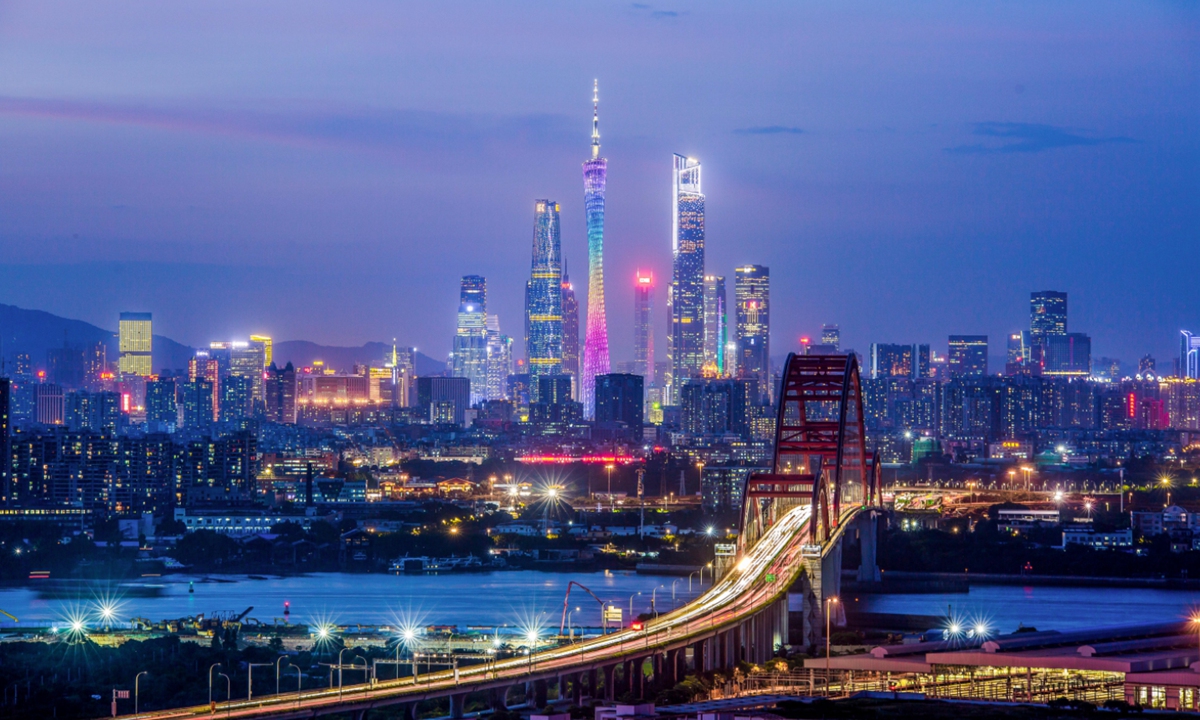
Night view of Guangzhou's CBD in South China's Guangdong Province Photo: VCG
The monumental full length reportage
Ballet of Commerce: The Epic of Guangdong's Foreign Trade by famous writer He Jianming is set to make its debut at the Southern China Book Fair from August 27 to 31 in Guangzhou, South China's Guangdong Province.
Published by the Guangdong Education Publishing House, the book is the first of its kind to offer a panoramic account of Guangdong's millennium of trade and will be presented as a special offering for 2026's APEC "China Year," Xu Xiaofeng, an editor with the publishing house, told the Global Times on Monday.
China will host the 33rd APEC Economic Leaders' Meeting in Shenzhen, Guangdong in November. It will be China's third time hosting the event, following Shanghai in 2001 and Beijing in 2014.
He, a former vice chairman of the China Writers Association and recipient of the Lifetime Achievement Award for Chinese Reportage Literature in 2023, told the Global Times on Monday that as the world watches the evolving trade relationship between China and the US, there is a growing need for a book that can help Western readers gain a deeper understanding of China's trading culture and how Chinese people have conducted business throughout history.
Guangdong marks the starting point of China's thousand-year maritime trade with the world. Through its foreign trade trajectory, the book reflects China's broader trade evolution, the enduring values of the Chinese spirit in the modern era, and the distinctive civilizational traits that have shaped China's rise, He noted.
Guangdong is both the birthplace of the ancient Maritime Silk Road and a pioneer of China's reform and opening-up. As a vital artery of commercial exchange between China and the rest of the world, the Maritime Silk Road has witnessed the evolution and transformation of the Chinese economy over the centuries.
During the Sui (581-618) and Tang (618-907) dynasties, silk was among the main goods transported along the route, earning it the name "Silk Road." During the Song (960-1279) and Yuan (1279-1368) dynasties, porcelain became a major export commodity, leading the route to be known as the "Porcelain Road." By the Ming (1368-1644) and Qing (1644-1911) dynasties, tea had emerged as a sought-after Chinese export in Europe, giving rise to yet another name - the "Tea Road," according to a report by the Counselor's Office of the Guangdong Provincial People's Government.
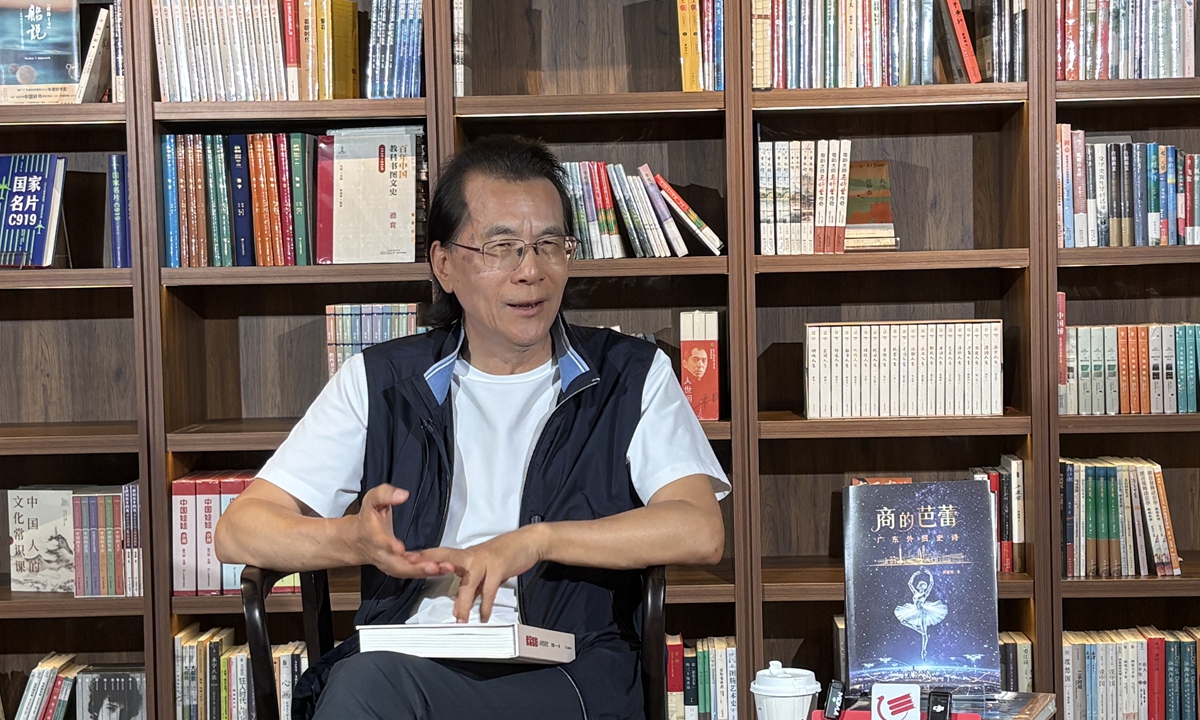
He Jianming talks about his new book on August 10. Photo: Wu Jie/GT
Mutual benefitGuangdong, China's largest foreign trade province, accounts for about one-fifth of the country's total trade and imports. As a major manufacturing hub with deep and extensive industrial chains, it creates significant demand for production factors, the Xinhua News Agency reported.
In the first half of this year, Guangdong's foreign trade reached 5.49 trillion yuan ($810 billion), surpassing the 5-trillion-yuan mark for the first time in the same period on record. The figure represented a year-on-year increase of 20.8 percent and accounted for 21.6 percent of China's total foreign trade. The province contributed an additional 944.71 billion yuan in trade volume, accounting for 25.6 percent of the country's foreign trade growth, according to official statistics released in July.
Having interviewed over 100 enterprises and institutions, He said that the book revisits the enduring legacy of the Maritime Silk Road, highlighting the exchanges between China and the West and the fusion of diverse civilizations.
"At the heart of Chinese business culture is the belief that 'harmony is the most valuable.' Rooted in traditional Chinese culture, this philosophy emphasizes cooperation and mutual benefit. Rather than viewing strength as a means to overpower others, Chinese merchants have traditionally embraced the idea that prosperity should be shared. When one grows stronger, others can benefit and achieve success together. This aspect of Chinese commercial culture remains unfamiliar to many in the Western world," said the 70-year-old writer.
Wang Yuanlin, a professor at the School of Humanities Guangzhou University, told the Nanfang Plus (a Guangdong-based news platform) that mutually beneficial and fair foreign trade policies, together with Guangdong merchants' long-standing tradition of integrity and win-win cooperation, have been key factors behind the province's enduring success in foreign trade.
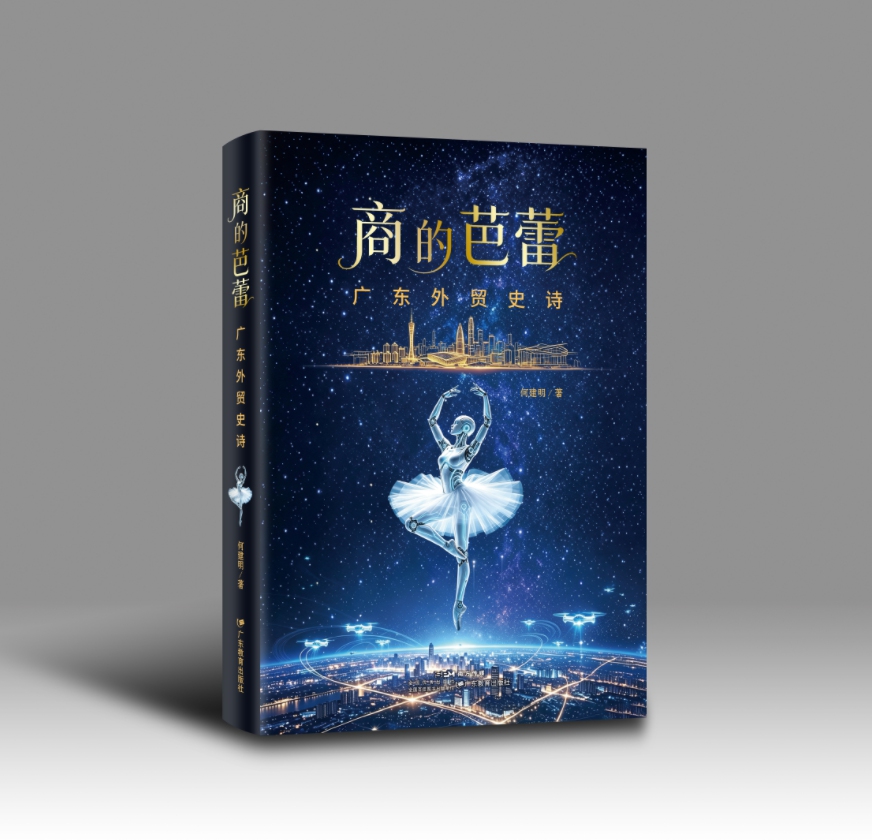
Ballet of Commerce: The Epic of Guangdong's Foreign Trade by He Jianming Photo: Courtesy of Xu Xiaofeng
Elegant businessThe author said that the choice of "ballet" in the book's title reflects the idea that Chinese business practices have developed into an art form - one characterized by balance and elegance.
"I want the Western world to understand that when the Industrial Revolution was just beginning and the Renaissance was sweeping across Europe, Chinese people had already mastered the art of commerce," He said.
Through conversations with entrepreneurs ranging from grassroots business founders to prominent corporate leaders such as Dong Mingzhu, chairperson of Gree Electric Appliances, He chronicles Guangdong's transformation from a millennia-old trading hub into a global industrial powerhouse.
"Just imagine: Employees at a private company can step into a space capsule after lunch and take a nap in their own private sleeping quarters. With a company like that, how could it not succeed?" he said.
From the exchange of handcrafted goods in the agricultural era to today's trade in high-tech products such as semiconductors and drones, Chinese people have developed a business culture centered on the principle that "harmony is most valuable" over thousands of years of commercial exchange.
This cultural tradition has become a key in driving the continued growth of trade in Guangdong and across China, He added.
。

B | 聚焦师幼互动
共情构建美好
开福区水映加州幼儿园
每一次学习都是自我的成长
每一次奔跑都只为凝聚更好的教育能量
为帮助教师更好地理解与运用共情式教育,提升共情能力和沟通技巧,增强对儿童心理发展关键经验的剖析与教学实践能力,从而更优质地服务幼儿及家长。2024年12月18日,我园特邀共情陪伴项目督导李闵园长开展了共情陪伴项目听评课暨教研活动。

C |
01
集体观摩共情活动
活动伊始,分别由小三班邓淳元老师、中四班陈丽老师、大四班颜宪哲老师带来共情课例观摩活动,让我们一起去看看吧!
小班《快乐之歌》
小三班邓邓老师带来的共情陪伴活动之《快乐之歌》。我们每天都会遇到很多开心的事情,通过视频引导,邓邓老师告诉幼儿可以笑,可以用唱歌或肢体动作等形式,表达自己的开心情绪。
中班《生气,我很生气》
中四班丽丽老师带来的共情陪伴活动是《生气,我很生气》。我们每个人都会有生气的时候,生气时我们心里会很不舒服、难过。丽丽老师通过图片、游戏引导幼儿把生气说出来,就会感觉好很多,别人才会知道发生了什么。
大班《一步一步往前走》
大四班哲哲老师带来的共情陪伴活动之《一步一步往前走》。

D | 哲哲老师基于对教材的分析,结合本班幼儿的生活实际,引导幼儿自主探索应对困难的方法,并以由易到难、循序渐进的方式面对和克服挫折。
02
集体教研说评课
观摩完三个活动后,共情陪伴项目组督导李闵园长、水映加州幼儿园陈园长和老师们聚集在一起,进行思维的碰撞,产生智慧的火花。
三位老师针对活动目标达成情况、活动开展前和活动实施中遇到的困惑进行了反思和复盘。听课老师们针对活动重难点、活动亮点、以及活动困惑与思考等方面进行了深入的交流研讨。

E |
最后,李园长对本次教研进行了专业点评和指导。李闵园长对开展活动的三位老师给予了肯定,同时对三个活动存在的问题分别进行了梳理。
03
专业引领促成长
共情式家园沟通
最后,李闵园长给我们带来的专题培训《共情式家园沟通》。
李闵园长先带我们一起回顾了共情陪伴的关键点,针对“共情式家园沟通”详细讲解了六个层次和十个步骤;在讲解中,李园长结合案例分享了一系列高情商共情陪伴解决方案,培训现场气氛热烈,教师们全神贯注地倾听,认真记录,力求更深刻地理解共情教育,掌握更多与家长和孩子沟通的有效技巧。
收获与启发
本次培训过后老师们也是收获满满,结合班级情况,对未来共情陪伴更好的开展做出了初步计划。
共
情
陪
伴
共情的最终目的,其实不是“要”把孩子培养成什么样子,而是通过共情,让孩子自己得以自然生长,长出更多源自于他内在的力量,进而发展出独立、自主、温暖地拥抱这个世界的能力。种子不会一天就发芽,让我们用爱滋养,用心陪伴。共情陪伴,你我同在。
END
编辑丨谭梦琳
一审丨首媛芝
二审丨首媛芝
三审丨陈扬眉。
Current article:http://www.liawucunsainantaonao.sbs/jlqh5/20aq.xlsx
Published on:02:56:29